Letters from a Pioneer Settler
Englishman William Ewens arrived in Port Adelaide on 25 September 1839 with his wife Sarah and his three young sons. He was 28 years old and a carriage maker. He wrote to family and friends in England.
Letters were written with a nib, pen and ink on a sheet of paper. The paper was then folded into the shape of a small envelope. This was sealed with wax.
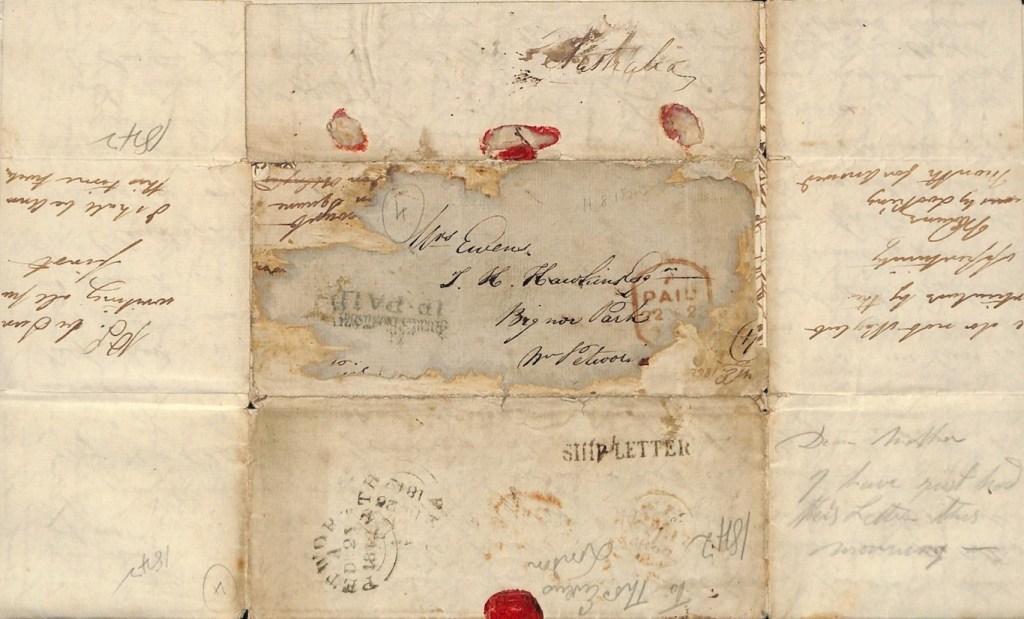
This was William’s mother, who was a servant at Bignore Park, a large estate in Sussex, England.
The red marks are the remains for the wax seal.
There is a stamp “SHIP LETTER”.
There are other stamps from the post offices in England.
To be able to write as much as possible, paragraphs were often not used.
Also, William frequently ignored punctuation so his sentences could be very long.
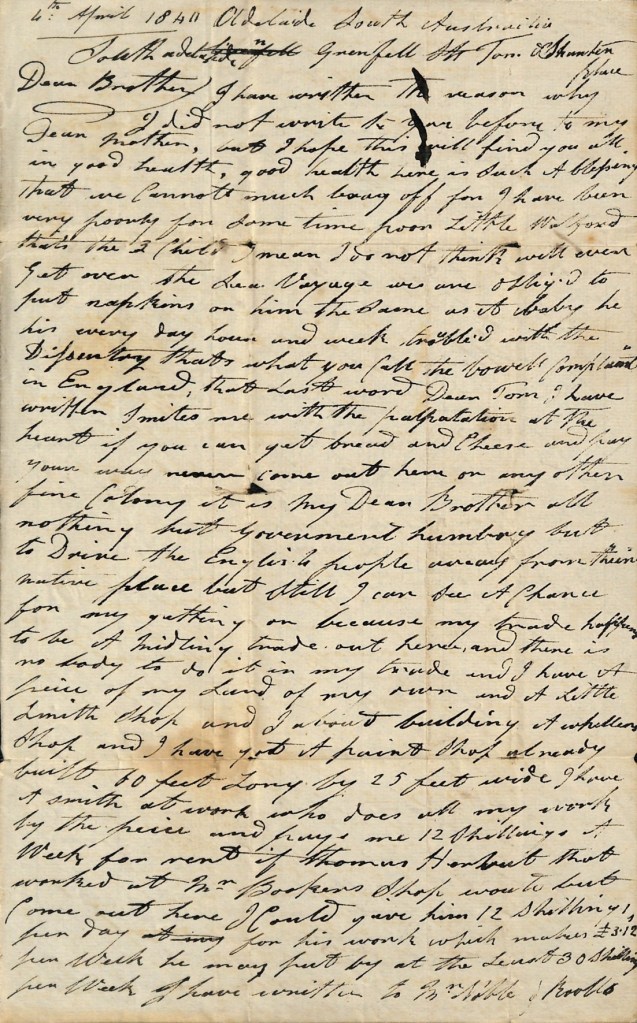
Frequently, when the page was full, the letter was turned sideways and the writing continued crosswise.

Letters were very important to the settlers. In 1842 William wrote about receiving letters:
“It is the only comfort we have to look for when a vessel arrives here. It is fine fun to see the people, all sorts and sizes, scrunching and pushing to get their letters. Growling. Swearing. Pushing. O to see the different Countenances. Some have good news, some -as the blacks say – no goody you.
P.S. Be sure do not neglect writing all particulars by the first opportunity. W. Ewens.
I shall be anxiously looking this time twelve months for answer.
Family
From William Ewen’s letters.
William Ewens, with his wife Sarah and her three children arrived in South Australia on the ship Prince Regent on the 25th September 1839. He wrote letters to his family and friends in England.
These are extracts from his letters describing his family.
1842 ” My children are growing up very fast, they are like a pair of stairs one after the other so regular. William is writing a letter to his grandmother, we do all we can to keep her in their memories. You see dear Tom I have now a large family five children, the youngest Sarah Burkitt is just like Mother as much as possible.”
1846 “I have repeatedly sent you Adelaide papers but have not received either letters, or papers from any of you till now for a very long time. I have never had an answer about the birth of my little girl Maryann Elizabeth who was born two years ago and now I have to inform you my wife has brought another daughter 6 months old now born Sept /45 total of my pickaninnies 7, 4 boys first 3 girls now. All alive hearty and well.’


What does the 1841 census tell us? W. Evans lived in Rundle Street with a total of 6 males and 1 female. Two males were under 35, 1 was under 14 and 3 under 7. The female was under 35 years of age.
Cost of Living
From Williams Ewens’ letters:
William Ewens, with his wife Sarah and three children, arrived in South Australia on the Prince Regent of the 25th September 1839. He wrote letters to family and friends in England.
This is an extract from one of his letters.
1839, soon after arrival
“Vegetables is Very Dear. Meat 1 shilling per pound. Butter 3 shillings. Dutch Cheese 5s each. Candles 2s 6d. Bread 3s 4 pound loaf. Eggs 4 pence each. Milk 8s per Quart.”
1840
“Beef and Mutton 8d Veal lamb and pork from 9d to 10d Bread 9d 2 pound loaf. fresh beutiful butter 1s 8d and 1s 6d. English Cheese 2s 6d and 3s per pound. tea sugar and spices rather cheaper than in England. Spirits about the same as in England. porter is 1s 4d and 1s 6d Ale 1s 6d and 2s per quart fish very plentiful good and cheap. Oysters dear 2 shillings a dozen”
1842
‘I will now give you our retail prices of articles we need for Consumption Beef from 2 to 5 pence per lb Mutton and lamb the same, port 5 pence fowls 3 shillings a pair, Butter 1d per lb for cheese and candle 7 pence Bread 10 pence a lb loaf. Every other article average the same. Spirits about the same as in England. porter 1s 4d and 1s 6d Ale 1s 5d and 2s per quart fish very plentiful good and cheap. Oysters dear 2 shillings a dozen.
How Things were Measured
Money;
£ = pound
s = shilling
d= = penny
pennies or pence = plural for penny
10 shillings = 1 pound
12 pennies = 1 shilling
Example: £1/2/6 = 1 pound, 2 shillings and 6 pennies
Measurement
Dozen = 12
Pound – a weight, nearly half a kilogram
Quart – a liquid measure, nearly 1 litre
Peck – a measure of dry (not liquid) goods eg apples
Bushel – a measure of dry (not liquid) goods eg wheat
So what did people eat?
Recipes for food and home help were sometimes published in newspapers.
PUMPKIN SOUP
Cut four or five thick slices of pumpkin into small pieces, put them on the fire with as much water as will cover the bottom of your saucepan : add eight or ten onions, and when all is sufficiently boiled to pulp, pass it through a cullender ; then put three or four onions previously sliced, when they are fried of a light brown, add to them your pulp, with as much milk as will render the whole of the consistency of thick cream. Toasted bread, cut in slices, is an improvement. Passengers going in a ship which carries a milch cow, may have an excellent soup from South Australia to England. Let any intended emigrant who reads this recipe try it. It is universally to be met with at the first tables in France. Care must be taken not to bruise the pumpkins. If they are hung up by the stalk to the ceiling, they will keep for many months.
Adelaide Observer 23 December 1843
APPLE JELLY
Take half-a-peck of apples, quarter and core them, but not peel them – put them into a stewpan with as much water as will cover them. When the fruit is in a wash, add a quart of boiling water – boil it half-an-hour longer, and then run it through a jelly-bag – next day aa to each pint of juice, three-quarters-of-a-pound of lump sugar; boil it very fast half-an-hour, or till it jellies, and be careful in taking off the scum as it rises to put it immediately into glasses. The juice and rind of the lemon, with fifteen grains of cochineal boiled together, should be added with the boiling water after the first boiling”
Adelaide Observer 17 October 1846
MUSHROOM CATSUP
Now that mushrooms are “as plentiful as blackberries,” the following recipe for this delicious sauce may not be out of place. We can vouch for its being “first chop.” – Take the largest broad mushrooms, break them into an earthen pan, strew salt over and stir them now and then for three days, then let them stand for twelve, till there is a thick scum over ; strain and boil the liquor with Jamaica and black peppers, mace, ginger, a clove or two, and some mustard seed. When cold, bottle it, and tie a bladder over the cork ; if wanted to keep for any length of time in three months boil it up again with some fresh spice.
Adelaide Observer 19 July 1845
INSTANTANTANIOUS BEER*
The American Housewife gives the following recipe for a temperance beverage :- Put a pint and a half of water, four teaspoons of ginger, a tablespoon of lemon juice, sweeten it to taste with syrup of white sugar, and turn it into a junk bottle. Have ready a cork to fit the bottle, a string to tie it down, and a mallet to drive down the cork. Then put into the bottle a heaped teaspoon of the super-carbonate of soda, cork immediately, tie it down, then shake the whole up well, cut the string and the cork will fly out. Turn and drink it immediately.
Adelaide Observer 17 October 1846 * This is non-alcoholic ginger beer.
MAKING VINEGAR
To eight gallons of clear rain water add three quarts of molasses, put into a good cask, shake well a few times, then add two or three spoonsful of good yeast cakes. If in summer place the casks in the sun ; if in winter near the chimney, where it may be warm. In ten or fifteen days add to the liquid a sheet of brown paper, torn in strips, dipped in molasses, and good vinegar will be produced. The paper will, in this way, form what is called the ‘mother’ or ‘life of vinegar.’ This looks reasonable, and, what is more importance, it is supported by the inductions of chemical science throughout.
Adelaide Observer 20 May 1848
GREASE SPOTS
Take the yolk of an egg, entirely free from the white (be sure not to scald the egg,) and with a soft brush apply the mixture, and rub it on the spot until the grease appears removed or loose. Wash off the egg with moderately warm water, and finally rinse off the whole with clean cold water. Should not all grease be removed, which may arise from being on a long time, or not sufficiently washed, dry and repeat the operation.
The writer of the above says that a fine Merino shawl, which had been badly smeared with tar and grease was perfectly cleaned by this process in a few minutes.”
Adelaide Observer 30 January 1847
 Pioneers SA Learning Hub
Leave a comment