The 1841 Census was undertaken when the colony was not 5 years old.
The distances and small population meant that coverage was poor. Most citizens lived close to Adelaide and were counted by the enumerators. Those living further out may have been missed.
Over 2900 households in Adelaide and in nearby villages nearly 9,200 people were covered.
A further 6,200 people were located beyond this area.
A total of 15,436 were recorded as living in the colony.
But it is uncertain how many people in total were living in the colony.
We know that 11,518 people arrived as free passengers by 1841. Records do not tell us how many people departed, arrived overland or arrived by coast or who paid their own passage.
The census was a long undertaking and was not done in a day or week.

The 1841 Census is the only Australian Census that is available for viewing. There is more information available here:

https://www.familysearch.org/ark:/61903/3:1:3Q9M-CSZV-YPF?i=11&lang=en

Transcription: ” Names of Natives at Port Lincoln Known to the Reverend Mr Schurman and J.B. Harvey”
The 1841 Census for Port Lincoln provided the names of 36 Aboriginal men. Four were under 14, five were under 21, 23 were under 35 and 4 were under 50. Additional information was given for the surrounding areas.
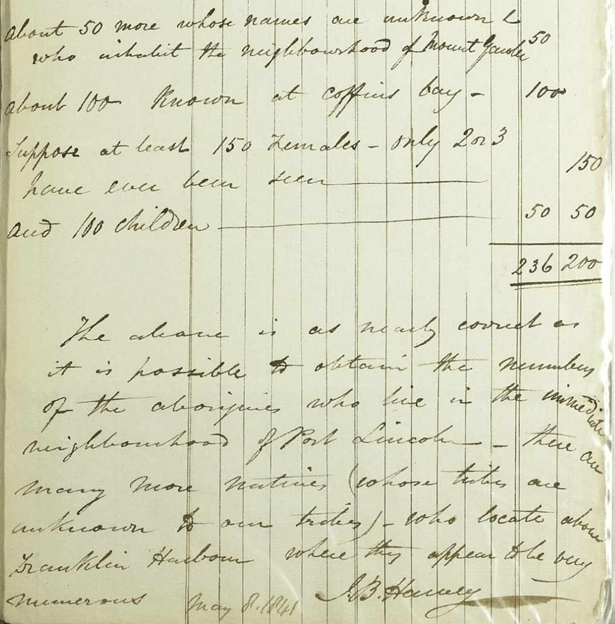
Transcription of the above document:
“About 50 more names are unknown and who inhabit the neighbourhood of Mt Gawler – 50
About 100 known in Coffins Bay 100
Suppose at least 150 females – only 2 or 3 have ever been seen
And 100 children
Total numbers include: 236 females and 200 males
The above is as nearly correct as it is possible to obtain the numbers of the aborigines who live in the immediate neighbourhood of Port Lincoln – there are many more natives (whose tribes are unknown to our tribes) – who locate above Franklin Harbour where they appear to be very numerous. J. B. Harvey, May 08, 1841.
In respect for the custom of many Aboriginal groups these names have not been transcribed.
“Often a deceased person’s name is not used again and a substitute name is used instead.”
So who was Reverend Schurmann and J.B. Harvey?
In September 1840 Schurmann had taken up a government position as deputy-protector of Aborigines at Port Lincoln. As an interpreter he often accompanied police investigations and travelled to Adelaide for Court proceedings but had difficulty harmonizing this work with his missionary activities. By the end of the year, he had collected 500 words of the Parnkalla (Banggarla) language. He repeatedly requested government support for an agricultural settlement and school for the Aboriginal population away from the influence of European settlers. In 1843 he was recalled to Adelaide a court interpreter and next year published a dictionary of 2000 entries called: “A Vocabulary of the Parnkalla Language, Spoken by Natives Inhabiting the Western Shores of Spencers Gulf
Australian Dictionary of Biography: https://www.google.com/search?client=firefox-b-d&q=australian+dictionary+of+biography

State Library South Australia B 70983
Dr James Benjamin Harvey was the first doctor in Port Lincoln, he was born in Tottenham, England. He was married to Sophie in 1836, aged 26 and set up practice as a surgeon in Devonshire. However, after 7 years the practice wasn’t doing that well and Sophie was beginning to show signs of chest troubles which wasn’t helped by the damp climate.
A fresh start in a warmer climate seemed a better option. Dr Harvey obtained a grant of land and the job of the Harbour Master at Port Lincoln in 1939. He was permitted to practise privately as a surgeon. He died in 1843 and was buried on Boston Island where he held land.
https://monumentaustralia.org.au/themes/people/medicine/display/51510-dr-james-benjamin-harvey
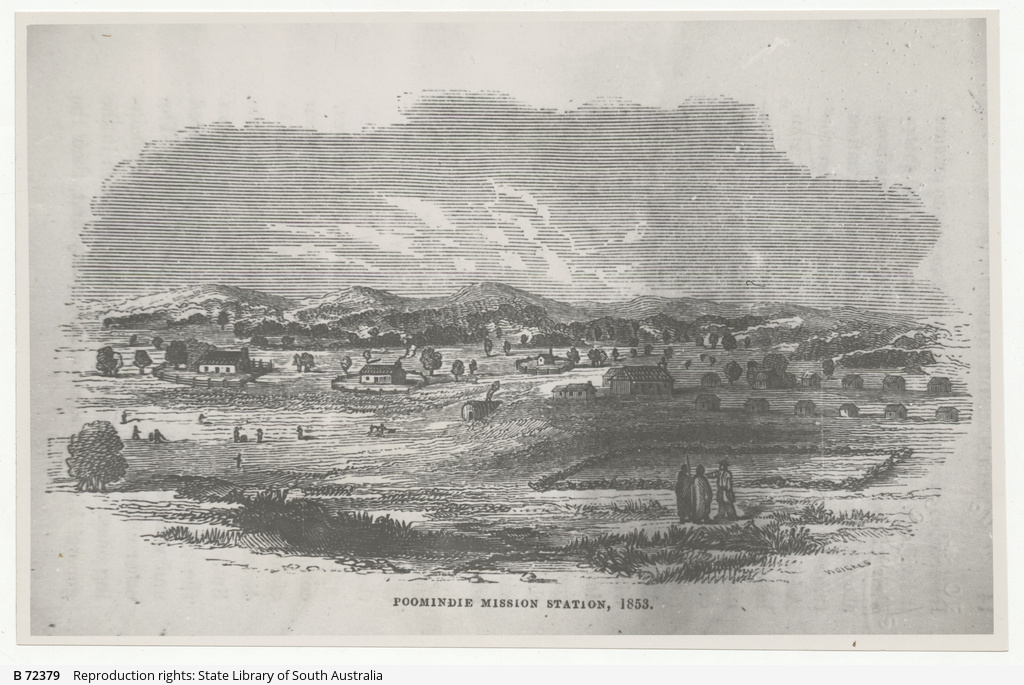
 Pioneers SA Learning Hub
Leave a comment